Authenticity, Integrity & Trust

Updated: Apr 13
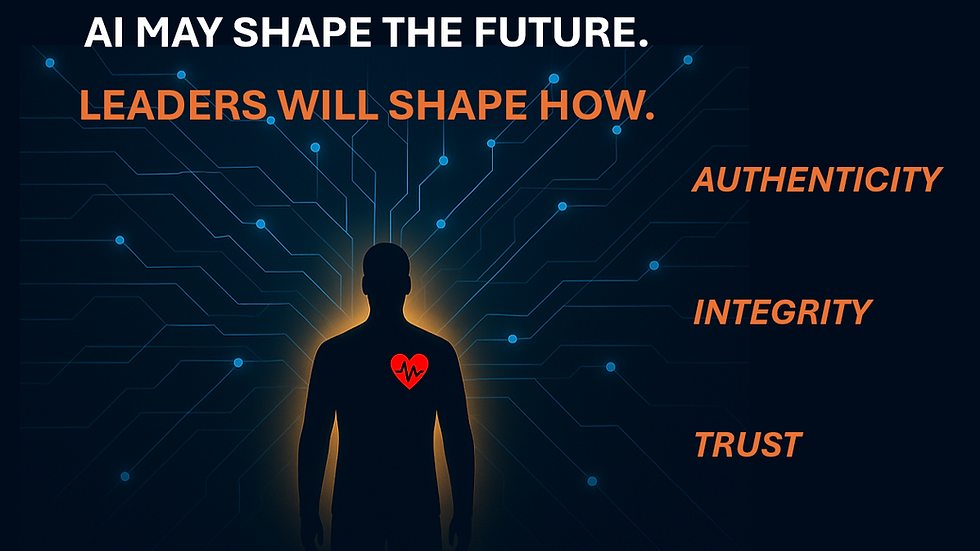
AI may change how we work, but how will it change the way we lead?
In many ways, we live in unprecedented times - exponential pace of technological advances, extreme market volatility, heightened geo-political tensions, all underpinned by the topic of the decade: AI.
At the center of all this are humans, with our own sets of values, beliefs, approaches and fears. Humans, by design, are pattern seekers. In uncertain times, we seek clarity, certainty and predictability. When these don’t appear naturally, we tend to create our own versions - reactive and improvised. That’s where suboptimal, rushed decisions are born which can have significant short- and long-term consequences.
While we, as leaders, cannot bypass the volatility and disruptions, we can, however, bank on time-tested principles of Authenticity, Integrity & Trust. They create the common constant that provides the room we need to make thoughtful, rational and balanced decisions. These values cut across eras because they capture the essence of what leaders are entrusted to do - serve all stakeholders including employees, customers, investors, and ultimately society at large. Nowhere are they being tested more than in the pursuit of AI greatness.
Technologically, we stand at one of the most significant inflection points in human history. Yet our collective approach often falls short. What could be the greatest gift technology has given us risks being squandered. Far too many AI initiatives stall in proof-of-concept purgatory. As I noted in my recent article on AI blockers, “The challenges aren’t just technical - they’re structural, systemic, and deeply human.” In this piece, I want to focus on that human dimension and in particular, the role of fear
The Role of Fear
Leaders today are under tremendous pressure from all dimensions - competitors, investors, boards, peers, and internal organizations - to showcase their own AI success stories. Amid constant disruption and uncertainty, leaders are under pressure to project certainty. Yet the reality is no one has it all figured out. In these moments of uncertainty, steps in fear - Fear of missing out. Fear of falling behind. Fear of not sounding smart. Fear of how investors, peers, or the board will react.
As my co-author, Guryan Tighe, highlighted in her recent article in Fast Company, fear doesn’t just sit quietly in the background - it actively drives poor decisions. It shows up in three ways: leaders freeze and avoid making calls, they rush head first into ill-considered bets, or they sidestep the hard conversations their teams and stakeholders need. Each of these erodes trust and credibility, often in ways that are hard to repair.
Fear-driven leadership creates short-term actions that may look good in headlines but undermine long-term value. If we can understand what these fears are showing us - we can see where to apply courage. The courage to be authentic when it’s easier to posture, to stay anchored in values when the crowd pulls elsewhere, and to lead with integrity even under pressure.
The Costs
Unlocking AI’s potential responsibly requires clear-eyed leadership. To rush in without discipline is to jeopardize trust, credibility, and long-term value. The risks are real and they compound one another. Among them:
Wasteful spending: Chasing head-line worthy stories with hastily built POCs, rather than deploying capital with discipline and thoughtfulness. We may end up exhausting the very capital and human resources needed to win, creating further pressures.
Misrepresentation: AI-washing- Repackaging business-as-usual as AI innovation to show progress, eroding credibility and trust both inside and outside the organization.
Premature & Misguided Workforce Actions: Workforce Harm - reactive cuts driven by misallocated spending and pressure to ‘show’ progress
Environmental cost: Scaling without regard to resource use or sustainability.
Erosion of long-term value: Prioritizing optics and short-term wins over building durable, responsible advantage.
These risks feed on each other, creating a vicious cycle that undermines the very DNA of success.
Path forward & Call to Action
This is not a call to dampen ambition. It is a call to channel ambition responsibly. To embrace AI’s potential while holding fast to the timeless principles of leadership - Authenticity, Integrity & Trust. These are not soft virtues. They are the hard currency of leadership. The leaders who embody them will not only navigate today’s complexities, they will define tomorrow’s possibilities.
AI is new, fast-moving, and still full of unknowns. No one has all the answers. Pretending otherwise misleads employees, investors, and customers alike. True credibility comes not from posturing but from honesty. From saying “we do not yet know, but we are learning.” From being transparent, genuine, and real.
And here’s a reminder worth holding onto: not everything is everything. Not every AI pursuit is created equal. Listen, assess, and prioritize - reserve firepower for the meaningful, long-term value-creating bets, while having the courage to say no to the distractions that don’t move the needle. Be clear-eyed about your goals: what builds AI literacy, what delivers impact today, and what will matter most in the years ahead. Let's explore this more, later in the series.
For now, I invite you to join me in pausing before the next AI announcement, the next investment, the next board update. Ask yourself:
Am I leading from misunderstood fear, or from integrity and authenticity?
Am I inspiring trust, or am I adding to the confusion?
Am I reacting to the short term noise, or am I leading with intentionality and purpose?
The answers will define not only our credibility today, but the legacy we leave for tomorrow.
#AILeadership #Authenticity #Integrity #Trust # Transformation #ArtificalIntelligence #RealImpact


